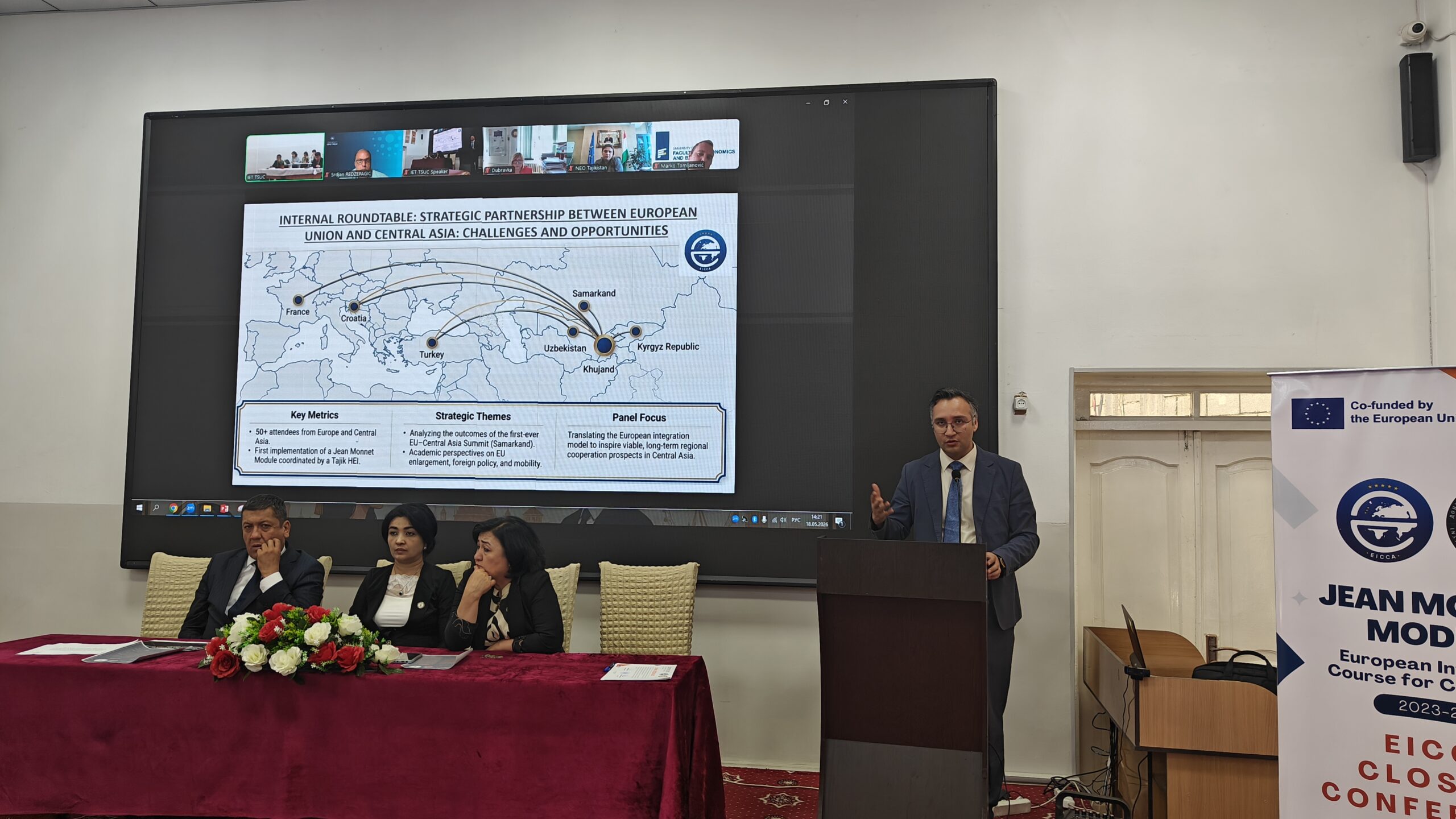
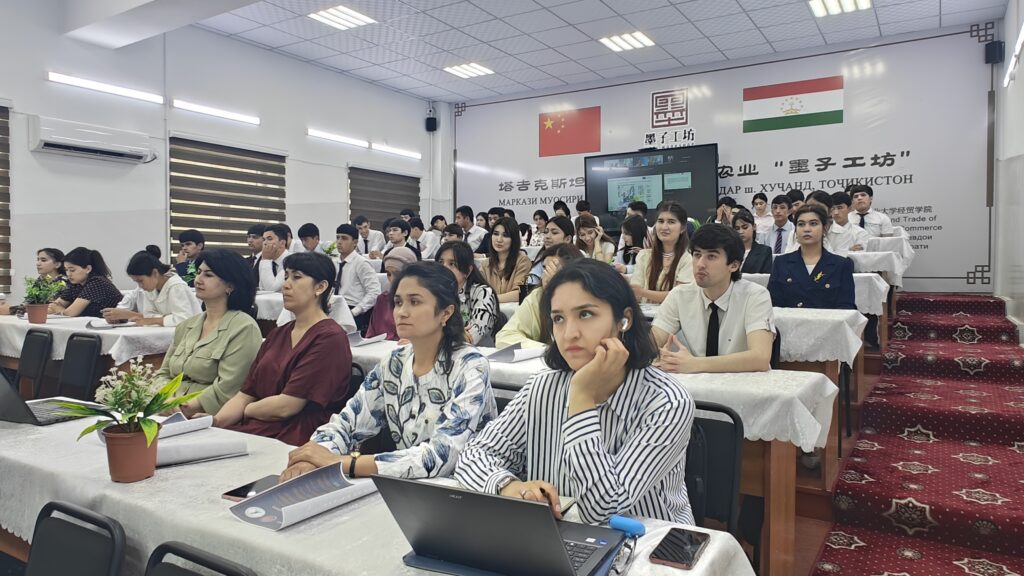
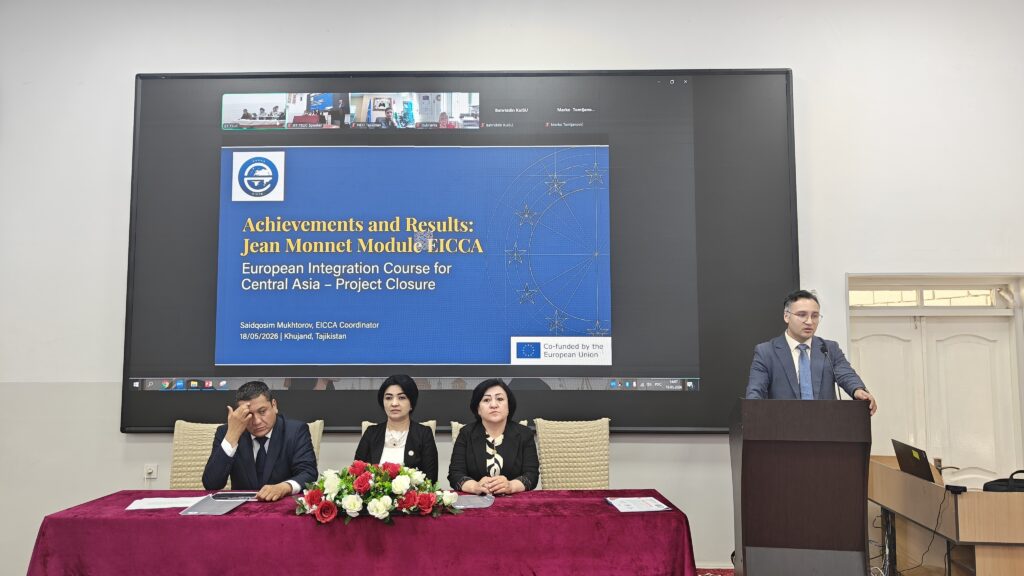
On May 18, 2026, the Jean Monnet Module «European Integration Course for Central Asia» (EICCA), coordinated by the Institute of Economy and Trade of the Tajik State University of Commerce (IET TSUC), successfully held its grand final Closing Conference. The high-profile hybrid event took place in the Building 2 Grand Hall of IET TSUC and served as the comprehensive culmination of the landmark project spanning from 2023 to 2026. Bringing together institutional leadership, national representatives, international academic experts, local faculty, and an audience of over 100 students and specialists, the conference celebrated a historical milestone: the successful completion of the first-ever Jean Monnet project coordinated directly by a higher education institution in Tajikistan.

The conference commenced with official welcome remarks from Dr. Zokirkhonzoda M.Z., Vice-rector of IET TSUC, who emphasized how the EICCA project has permanently elevated the international status and pedagogical innovation of the university. This was followed by a strategic address from Dr. Nakhatzoda Mohbonu, Coordinator of the National Erasmus+ Office in Tajikistan, who highlighted the profound structural importance of having Tajik higher education institutions directly coordinate Jean Monnet initiatives to accelerate integration into the global academic landscape. The academic core opened with a distinguished keynote speech delivered by Prof. Dr. Sc. Dubravka Aksamovic from the Josip Juraj Strossmayer University of Osijek, focusing on the expansive, strategic value of building knowledge networks and cross-regional cooperation through European Union studies beyond Europe’s borders.

A central element of the conference was an exhaustive, data-driven project closure presentation delivered by the EICCA Project Coordinator, Saidqosim Mukhtorov. Mr. Mukhtorov meticulously outlined the operational journey and structural deliverables achieved across the three-year lifecycle of the alliance, which successfully united the localized execution of IET TSUC with top-tier international expertise from France and Croatia. Crucially, he noted that the academic course was successfully materialized via a newly developed 4 ECTS curriculum supported by the official EICCA Coursebook. He broke down the four main pillars of this open-access resource: Foundations of European Integration (F. Okhunov & S. Qobilov); The EU Internal Market and Economic Integration (D. Mirpochoev); Sectoral Policies of the European Union (T. Tukhtaev); and EU Enlargement, Data-Driven Governance, and Global Influence (S. Mukhtorov). Mr. Mukhtorov emphasized that the course uniquely bridged theory with reality by fully integrating live Eurostat data navigation exercises, interactive case studies, and localized regional problem-solving tasks. He concluded by detailing the project’s wider dissemination footprint, including initial faculty orientation seminars, methodological teaching workshops, Silk Road International Innovation Summer Camps, and the project’s centralized digital infrastructure.
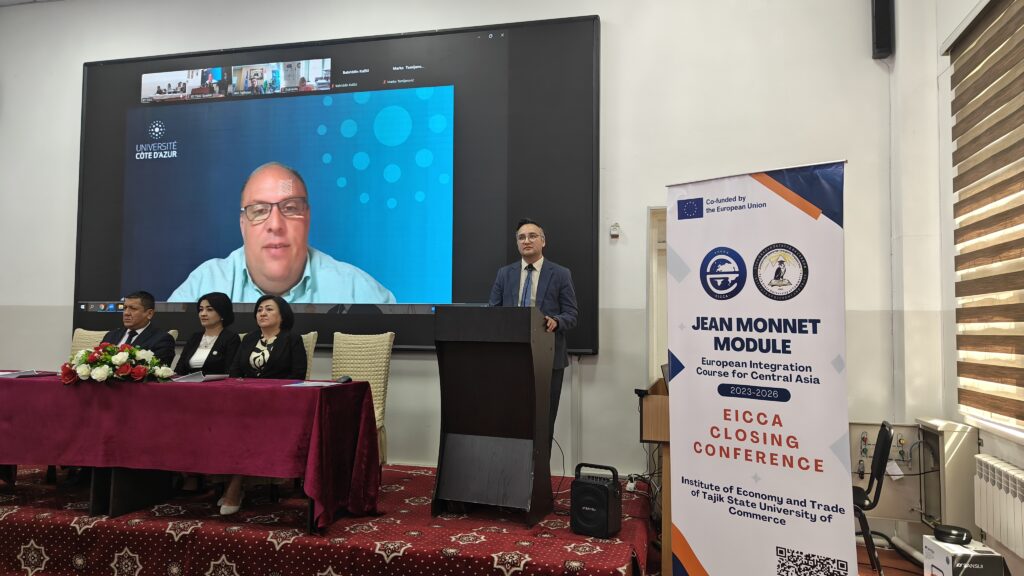
The conference then transitioned to specialized academic reporting from international and local experts:
• Prof. Srdjan Redzepagic (University of Côte d’Azur, France) delivered an empirical presentation on the role of quantitative facts and trade figures within economic integration, urging that regional partnerships and trade policy formulation must be anchored in rigorous macroeconomic data metrics.
• Assoc. Prof. Marko Tomljanovic (University of Rijeka, Croatia) presented new pedagogical insights for teaching international modules, underscoring a strategic shift toward active student participation, interactive problem-based learning, and policy simulations to help students internalize complex global institutional frameworks.
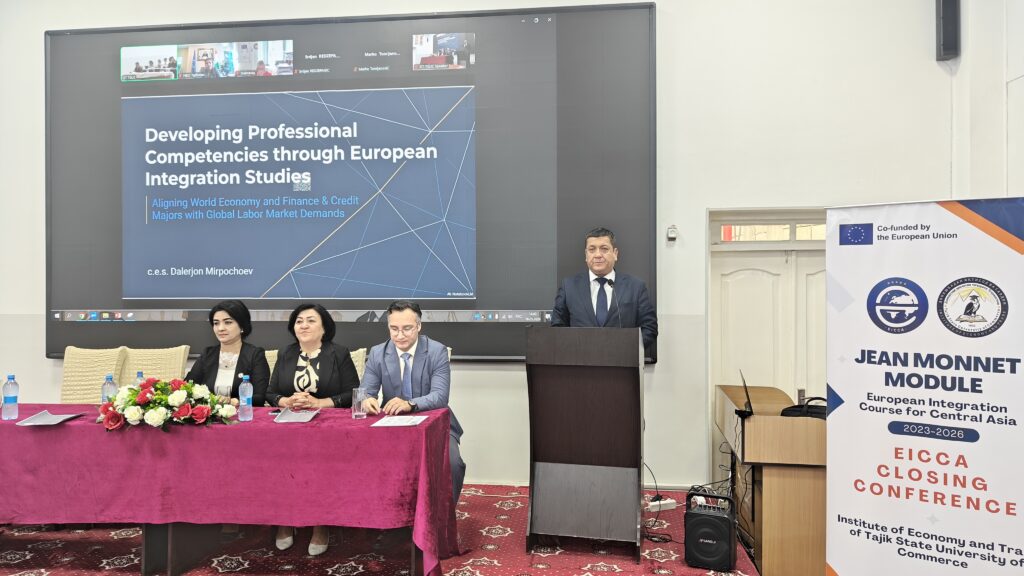
• Assoc. Prof. Dalerjon Mirpochoev (IET TSUC, Tajikistan) provided a localized case study proving why EU economic studies are vital for World Economy specialists in Tajikistan, detailing how a solid understanding of European single market rules and regulatory compliance gives Tajik graduates a competitive edge in international commerce.Shifting the focus to student outcomes, EICCA Project Manager Firuz Okhunov presented an in-depth analysis of student perceptions regarding European studies. His findings demonstrated how the modular course actively reshaped student viewpoints, fostering critical thinking and sparking original student ideas on cross-border resource sharing, market connection, and cooperative problem-solving frameworks within Central Asia.
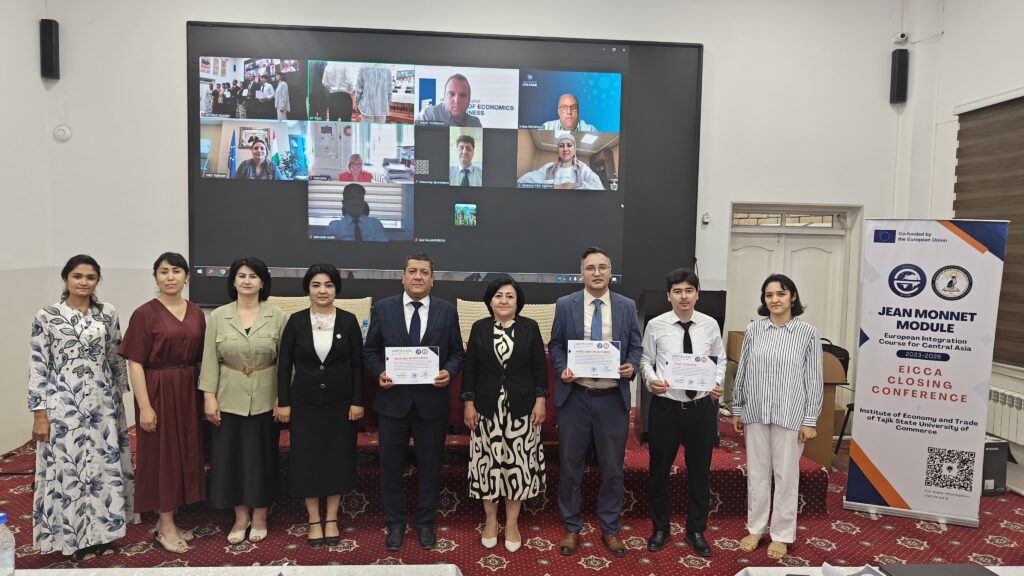
The event successfully concluded with an interactive, lively Q&A session moderated by Saidqosim Mukhtorov, which brought together faculty, speakers, and students to discuss future sustainability plans and continuous academic exchange. The session was finalized with the formal presentation of institutional certificates to the core project implementation team, expert panels, and speakers. This concluding task stands as a definitive, monumental milestone for the EICCA project and higher education in Tajikistan, establishing an outstanding baseline for internationalized, data-driven academic cooperation in Central Asia.



Добавить комментарий